Choosing between bariatric equipment and standard rehabilitation products requires more than comparing prices or appearance. The real question is, “Why is bariatric equipment different from standard rehab products?” The answer begins with design assumptions. Bariatric products support larger body weights, wider body dimensions, higher transfer forces, and greater stability demands. A standard wheelchair may fit through a doorway, yet its frame, seat width, and braking system may not withstand repeated heavy transfers.
“Bariatric design is about safety margins, not simply making equipment wider,” says James R. Whitaker, a bariatric rehabilitation equipment specialist with clinical procurement experience. His point is practical. A reinforced commode, therapy table, or patient lift should match the user’s weight, shape, mobility, and transfer method. Check the safe working load. Measure doorways, seat height, turning space, and caregiver access. Small details matter.
Look closely.
Standard rehabilitation products often prioritize portability, compact storage, and general clinical use. Bariatric equipment usually emphasizes reinforced frames, broader contact surfaces, stronger casters, and improved pressure distribution. These features can increase cost and reduce maneuverability. That trade-off deserves honest discussion.
Experience also exposes a common mistake: selecting equipment from body weight alone. Weight can change. Functional ability can change faster. I have seen product comparisons overlook fatigue, uneven flooring, sling positioning, and emergency access. Manufacturer specifications remain essential, but they are not the whole assessment. This guide compares both categories through safety, durability, comfort, space requirements, maintenance, and long-term value, while acknowledging that no single product fits every rehabilitation setting.
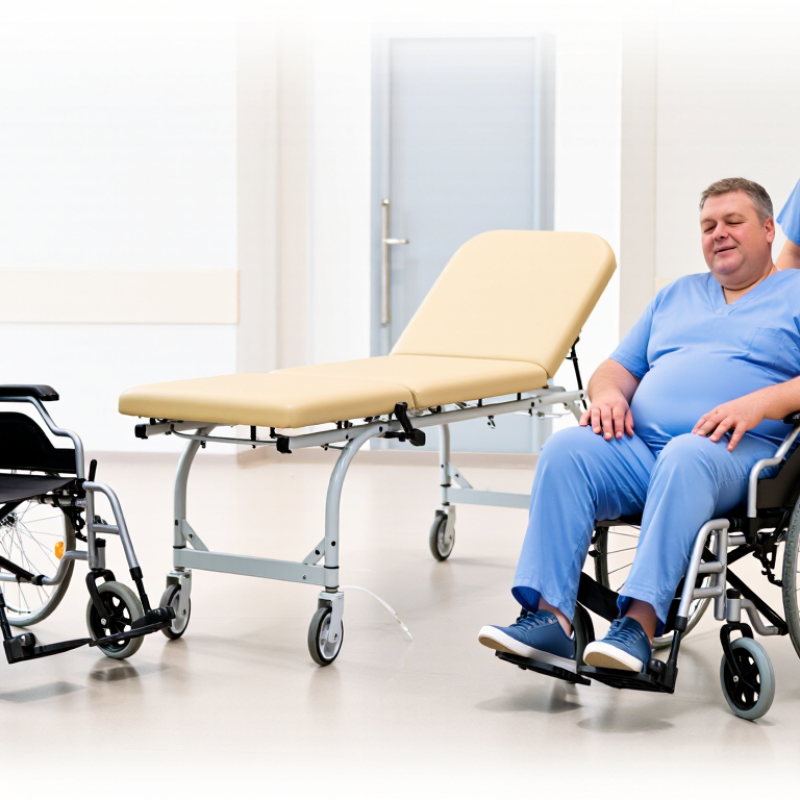
BMI ≥40 is a practical warning point, not a complete equipment assessment. The Centers for Disease Control and Prevention reported severe obesity in 9.2% of U.S. adults during 2017–March 2020. The World Health Organization also reported that 1 billion people worldwide were living with obesity in 2022. These figures show why rehabilitation teams must look beyond average patient profiles.
Bariatric equipment is designed for higher safe working loads, wider seating, stronger frames, and greater stability. Standard walkers, transfer benches, wheelchairs, and therapy tables may fail when weight exceeds their tested limits. Check the patient’s current weight, transfer ability, body shape, fall risk, and expected changes during treatment. BMI helps identify need. It does not replace direct measurement.
A 160-kilogram patient may have a BMI below 40 but still exceed a standard device’s safe limit. Conversely, a taller patient with BMI above 40 may need specialized support without requiring every bariatric product. The Agency for Healthcare Research and Quality links safe patient handling programs with reduced staff injury risk, supporting careful equipment selection. Read the full load rating. Do not rely on appearance.
Capacity is only one detail. Brake access, armrest clearance, sling fit, turning radius, and caregiver space matter during a real transfer. I have seen teams choose wider equipment too late. That delay can increase fear and strain. The checklist is useful, but imperfect. Reassess after weight change, mobility decline, or a near miss.
Comparing bariatric equipment with standard rehabilitation products starts with safe working load, not appearance. Standard devices often support about 250–300 pounds, while bariatric models commonly support 500–1,000 pounds. That difference matters during transfers, standing exercises, and repeated daily use. The CDC’s National Health and Nutrition Examination Survey reported adult obesity at 40.3% in 2021–2023. A 300-pound limit can therefore become a clinical risk, not a theoretical number.
In practical assessments, I check the patient’s weight, clothing, equipment attachments, and movement pattern. A transfer bench rated for 500 pounds may still fail if the user shifts suddenly or the floor is uneven. Safe working load should not be confused with maximum user weight. The manufacturer’s test method, dynamic-load rating, and inspection schedule deserve equal attention. OSHA’s Safe Patient Handling guidance also emphasizes reducing manual lifting and using suitable assistive equipment. That guidance supports a broader lesson: capacity protects both patients and caregivers.
The larger rating is not automatically better. Some oversized products restrict positioning or make home storage difficult. I have also seen teams choose standard equipment because it looks familiar. That shortcut can ignore fatigue, repeated loading, and real-world instability. A 1,000-pound rating provides useful margin, but only when the frame, casters, seat, and accessories share compatible ratings. Check every component. Recheck the decision when mobility, weight, or care needs change.
Safe working load comparison: standard rehabilitation products commonly support approximately 250–300 lb, while bariatric products are typically designed for substantially higher loads, ranging from 500–1,000 lb depending on equipment type and configuration.
The ranges show representative safe working load bands commonly specified for rehabilitation equipment. Always verify the product label, technical documentation, patient weight, accessories, and intended-use conditions before selection.
Comparing bariatric equipment with standard rehabilitation products starts with usable space, not weight capacity alone. Measure the full width, length, handrails, footrests, and transfer zones. Wider frames can reduce passage clearance quickly. During site checks, I have seen equipment fit through a doorway but block the turning area beside a bed. That mistake can delay care and increase staff repositioning.
Use ADA’s 60-inch turning-circle benchmark as a practical screening measure. It describes a circular turning space, although accessibility requirements depend on the location and applicable standards. Mark a 60-inch circle on the floor, then test the equipment in its occupied position. Check entry, rotation, transfer, and exit paths. Include door swings, wall-mounted fixtures, and caregiver movement. Do not treat 60 inches as a magic answer. Some bariatric devices need more space because users and caregivers require additional clearance. This is where basic comparisons become less certain.
Tips:
Measure the widest working position, not the folded frame. Record clearances in inches. Test with a wheelchair, transfer board, or walking aid nearby. Photograph tight corners for later review. Ask staff to repeat the movement several times; one successful turn may hide a practical problem. Recheck measurements after adding cushions, side supports, or removable trays. My own early assessments sometimes missed those small additions, and they changed the room’s usable space.
How to Compare Bariatric Equipment vs Standard Rehab Products?
Bariatric equipment must be compared through safety evidence, not appearance or advertised capacity. ISO 10535 applies to many patient hoists and transfer devices. It addresses testing, lifting performance, stability, and safe working loads. IEC 60601-2-52 focuses on medical beds, including essential safety and performance requirements. These standards are not interchangeable. A bariatric bed may meet one standard, while a patient lift requires another assessment.
In practice, check the exact product category before reviewing certificates. Confirm the tested safe working load, mattress platform width, castor stability, emergency lowering, and entrapment controls. Standard rehabilitation products may fit smaller users and lighter routines. Bariatric models need stronger frames, wider access, and more controlled movement. A certificate can look reassuring, but it may cover only one configuration. I would not rely on a supplier statement alone. Request test reports, declaration documents, maintenance instructions, and inspection records.
Tips: Measure doorways, turning areas, and transfer routes before purchase. Ask an occupational therapist or qualified biomedical engineer to assess real use. Observe transfers with suitable staff and equipment. Record user weight, posture needs, and sling compatibility. Do not treat maximum capacity as a daily target. Even careful comparisons can miss workflow problems, especially when rooms are crowded or staff training is uneven.
| Comparison Dimension | Bariatric Equipment | Standard Rehabilitation Products | Verification Point | Relevant Standard |
|---|---|---|---|---|
| Typical intended user load | Often designed for working loads of approximately 180–320 kg, depending on the product category and configuration. | Commonly designed for working loads of approximately 100–180 kg, depending on the product and model. | Confirm the safe working load, patient weight limit, accessory limit, and whether the limit changes with attachments or bed position. | ISO 10535 for patient hoists; IEC 60601-2-52 for medical beds. |
| Overall frame and base width | Frequently uses a wider, reinforced frame; mobile hoist bases may be approximately 700–1,000 mm wide when opened. | Often uses a narrower frame; mobile products may be approximately 550–800 mm wide when opened. | Measure doorways, lifts, corridors, turning areas, and clearance around beds before purchase. | ISO 10535 test documentation should cover the complete hoist configuration. |
| Patient support surface width | Bariatric bed platforms are commonly wider than standard beds, often around 1,000–1,200 mm. | Standard rehabilitation bed platforms are commonly around 850–1,000 mm wide. | Check usable mattress width, side-rail clearance, transfer space, and compatibility with pressure-redistribution mattresses. | IEC 60601-2-52 applies when the product is a medical bed within its scope. |
| Structural reinforcement | Typically includes reinforced deck sections, stronger casters, larger lifting columns, and higher-capacity joints or actuators. | Usually optimized for routine clinical use with lower structural and actuator loads. | Request load-test records, fatigue-test evidence, maximum-angle test results, and inspection intervals. | ISO 10535 includes performance and test requirements for hoists; IEC 60601-2-52 includes medical-bed safety requirements. |
| Hoist lifting range | A typical mobile patient hoist may provide a lifting range of approximately 500–1,900 mm, depending on boom and spreader-bar design. | A typical standard hoist may provide approximately 450–1,800 mm, depending on configuration. | Verify the minimum and maximum lifting points for floor transfers, bed transfers, bathing, and chair transfers. | ISO 10535. |
| Castors and mobility | Often uses larger or higher-rated castors, reinforced brakes, and a wider base to improve stability under higher loads. | Usually uses smaller or standard-rated castors intended for conventional indoor rehabilitation environments. | Check castor load rating, braking performance, threshold clearance, turning radius, and floor compatibility. | ISO 10535 for hoist testing; IEC 60601-2-52 for applicable bed mobility and stability requirements. |
| Side-rail and entrapment considerations | Requires careful compatibility checks because wider mattresses, extensions, and bariatric rails can change gaps and entrapment risks. | Usually uses standard mattress and rail dimensions, but gaps can still change when accessories are added. | Verify rail position, mattress thickness, deck extension, gap dimensions, pinch points, and accessory combinations. | IEC 60601-2-52. |
| Electrical system and protection | May require higher-capacity actuators, batteries, charging systems, and cables to move heavier loads safely. | Generally uses lower-capacity actuator and battery specifications suitable for standard patient loads. | Request electrical safety test reports, ingress-protection information, battery-cycle data, emergency lowering details, and cable inspection procedures. | IEC 60601-1 and applicable collateral standards may also be relevant; IEC 60601-2-52 applies specifically to medical beds. |
| Mattress and accessory compatibility | May require bariatric mattresses, longer straps, wider slings, extended side rails, and reinforced transfer accessories. | Typically uses standard mattress sizes, sling sizes, transfer boards, and rehabilitation accessories. | Confirm that each accessory has its own load rating and is approved for use with the exact base product. | ISO 10535 for hoist and sling systems; IEC 60601-2-52 for bed and bed-accessory compatibility. |
| Transfer and repositioning function | Designed to support higher-load transfers, repositioning, lateral movement, and assisted standing when the configuration allows it. | Designed for routine transfers, mobility training, gait support, and standard patient repositioning. | Assess sling fit, transfer path, caregiver access, patient posture, and emergency release procedures through practical trials. | ISO 10535 when a patient hoist is used. |
| Stability and tipping risk | Requires additional attention to center of gravity, base width, boom position, bed extension, ramp use, and uneven flooring. | Generally evaluated for conventional patient weights and standard operating environments. | Review stability test conditions and never exceed the specified operating surface, load, or angle limits. | ISO 10535 for hoists; IEC 60601-2-52 for medical beds. |
| Cleaning and infection control | May require higher resistance to frequent cleaning, stronger welds, sealed controls, and surfaces that tolerate hospital disinfectants. | Usually supports routine clinical cleaning, subject to the product's approved disinfectant list. | Check chemical compatibility, cleaning instructions, ingress protection, removable covers, and corrosion resistance. | Confirm the applicable medical-device and electrical-safety requirements for the product category. |
| Documentation required before purchase | Load-rating certificate, configuration-specific test report, risk-management file summary, service schedule, and approved accessory list. | Product specification sheet, user manual, routine maintenance schedule, and applicable conformity documentation. | Do not accept a general “compliant” statement without identifying the exact model, configuration, standard edition, and test scope. | ISO 10535 and/or IEC 60601-2-52, according to product type. |
Comparing bariatric equipment with standard rehabilitation products starts with the task, not the label. A transfer chair may need a wider seat, reinforced frame, and stable brakes for a heavier user. Yet width alone does not guarantee safety. Check the published safe working load, seat depth, armrest clearance, and floor space before selecting it. A product that fits the body but blocks a bathroom doorway can still fail in practice.
For mobility, compare turning radius, wheel placement, push handles, and surface stability. Standard walkers may suit short indoor steps, while bariatric walkers often provide stronger frames and broader bases. During toileting, measure the toilet height, lateral clearance, and caregiver position. Raised seats, commodes, and transfer benches should support controlled movement without forcing awkward twisting. Small details matter. Wet floors expose weak choices quickly.
Therapy equipment requires a different comparison. Parallel bars, treatment tables, steps, and exercise supports must handle repeated loading, not just a single transfer. Review height adjustment, locking systems, padding, and cleaning access. Observe the person performing the task, if possible. A checklist can miss fatigue, fear, or reduced hand strength. I have seen teams focus on maximum capacity and overlook transfer angles. That mistake deserves review. Equipment selection should involve clinicians, caregivers, and the user, with measurements documented and reassessed as mobility changes.
BMI of 40 or higher can signal a need for closer assessment. However, BMI does not replace direct measurement. A 160-kilogram patient may exceed a standard device’s safe limit. Check body weight, transfer ability, fall risk, and expected treatment changes.
Yes. Equipment limits matter more than BMI alone. A patient below BMI 40 may still exceed a walker, bench, or wheelchair rating. Read the full safe working load before selecting equipment.
Check seat width, armrest clearance, sling fit, brakes, and caregiver space. Turning radius also matters during real transfers. A wider frame may fit the patient but block a doorway. Capacity is only one detail.
Measure doorways, bed spaces, transfer zones, and the widest equipment position. Mark a 60-inch turning circle on the floor as a practical screening step. Test entry, rotation, transfer, and exit. One successful turn may hide a problem.
Wider frames reduce passage clearance quickly. A device may pass through a doorway but block movement beside the bed. Door swings, wall fixtures, footrests, and cushions can reduce usable space. Small additions matter.
ISO 10535 may apply to patient hoists and transfer devices. IEC 60601-2-52 focuses on medical beds. These standards are not interchangeable. Check the exact product category first.
Request test reports, declaration documents, maintenance instructions, and inspection records. Confirm the tested safe working load and product configuration. A certificate may cover only one setup. Do not rely on appearance.
Reassess after weight changes, reduced mobility, or a near miss. Repeat checks after adding cushions, side supports, or trays. Observe several transfers with trained staff. Our checklist may still miss workflow problems.
Why is bariatric equipment different from standard rehab products? The main difference is its ability to safely support users with a BMI of 40 or higher or a body weight beyond standard product limits. While standard rehabilitation equipment often supports approximately 250–300 pounds, bariatric options may provide safe working loads of 500–1,000 pounds. They are also designed with wider seats, stronger frames, reinforced supports, and additional stability for safer daily use.
When comparing products, evaluate whether their dimensions allow adequate clearance, including the ADA’s 60-inch turning-circle benchmark where applicable. Confirm that relevant equipment meets recognized requirements such as ISO 10535 for lifting and transfer devices and IEC 60601-2-52 for medical beds. Finally, match each product to its intended task, including transfers, mobility, toileting, and therapy. A proper comparison should consider user weight, room layout, caregiver needs, adjustability, durability, and safe working load rather than relying on appearance or price alone.

LDO Medical